Wednesday, February 13, 2013

My new Catholic Genealogy QuickGuide™: Let me help you find those Catholic ancestors!

There is much more to Catholic genealogy than just sacramental records.
The ecclesiastical paper trails left by our Catholic ancestors allow us to explore
their lives through important milestones painstakingly recorded by the church.
If you are researching Catholic roots, I'm sure you have a beginning understanding of the importance of Catholic sacramental records. Baptism and marriage records, in particular, are among the first of our ancestors' documents that we collect. They provide a wealth of information, allowing us to confirm names and family connections, link generations, and gain insight into important milestones in the lives of those who have gone before us.

In many countries, Catholic sacramental registries often served as both religious and civil records. In these cases, they may be the only evidence available to provide clues into the lives of generations passed. Yet, there is so much more to Catholic genealogical research. Church records (which take many forms beyond parish sacramental registries) and other Catholic resources offer a huge, often untapped resource.

After much research into this topic, I have created a Catholic Genealogy QuickGuide™, now available for purchase through Legacy Family Tree. I have perused all the published resources on the topic that I could find, done my own personal research using Catholic records, and put together an introduction to Catholic genealogy that I hope will provide help to both the beginning and experienced researcher.

My Catholic Genealogy QuickGuide™ contains descriptions of the history and types of Catholic records, what value they provide to the researcher, and where to find them. It offers a guide to assist you in following your ancestors' paper trails, and lists books, periodicals and online resources for help in researching Catholic roots in general and in understanding special topics related to specific ethnic groups and parts of the world. I've also provided some help in getting started with Latin language record translation.

If you have Catholic ancestors, I hope you'll allow me to share what I've learned with you. Visit Legacy Family Tree's website for more information. It is my hope that I can help you begin to understand the wealth of resources available to you in your search for Catholic roots!

Wednesday, January 23, 2013

It is hard to say good-bye to these dear women

This month, within the span of a week's time, I lost two very special ladies: my beloved Aunt Barbara and my dear Great Aunt Molly.

Barbara
Molly
It is hard to say good-bye to these women.

They each lived many states away from me, and that has been the case for most of my years (with the exception of my early childhood and a few years about a decade ago when I had the joy to live close to one of them). Yet, they each figured largely in my life in ways that they may not have even realized.

First as a child, then as a young lady and a grown woman, I have often looked to the women in my family for inspiration and example. I have gained courage for my own life through their stories, their struggles and their vibrant personalities. They have walked ahead of me on the journey through girlhood into adulthood, but we share so much - the same larger than life ancestors who have helped to shape us; the same struggle to make sense of and to find courage for the challenges in the life of a woman.

I have often been inspired by the stories of women ancestors that I never had the chance to meet, yet these dear aunts have touched me in a special way. Both had lively personalities, a great sense of humor, and unrelenting strength of will which gave them the ability to overcome their own personal difficulties. I will remember Barbara especially for her warmth, openness and honesty. I will remember Molly for her delightfully spunky personality. I have been blessed that my life crossed paths with each of theirs, if even for short time, and that I have had the gift of their sweet and strong influences over the years.

Rest in peace, sweet ladies. You are both very dear to my heart.

(This tribute to my aunts Barbara and Molly has been cross-posted over at my blog Small-leaved Shamrock.)

Saturday, January 5, 2013

Five years of life in the Lower East Side: 1908-1913

It was five years ago that my interest was sparked by Jim Rasenberger's January 2008 Smithsonian Magazine article entitled "1908: The Year that Changed Everything".

As I wrote after reading:
"It was a banner year for the Wright Brothers and their flying 'aeroplane'.
It was the year that Henry Ford's Model T went into production and the year that General Motors was founded.
1908 saw the race to the North Pole, the automobile race from New York to Paris, and the race to liberate the housewife via electric irons and toasters.
It was a year of tremendous change for the world and for the nation that had seen the Louisiana Purchase and Lewis and Clark's trek across the west only a century before.

1908. One-hundred years ago today.

Where was my family?"
It was a blog post that started a wave of responses. I had asked myself and my fellow genealogy bloggers the question: Where was your family in 1908? (You can read their responses here at Snapshots of the World Back in 1908.)


~

Five years have flown for me.

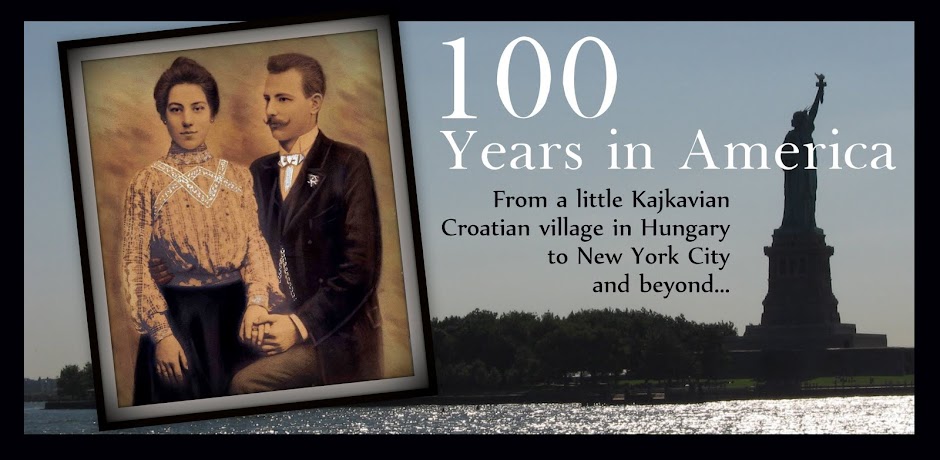
When I read Randy Seaver's latest Saturday Night Genealogy Fun challenge to write about the whereabouts of my ancestors one-hundred years ago in January 1913, I just had to find the time to do this exercise again. After all, this blog is called 100 Years in America!

In January 1908, my great-grandparents Ferencz and Ilona Ujlaki had been an ocean apart. He had immigrated to the U.S. and was trying to establish a new life for himself in New York before his wife and young son would join him. It would be another year before Ilona and the younger Ferencz would leave their native Legrad and make the ocean voyage from the port of Rijeka to New York City.

Fast forward five years to 1913. Much had changed for this little family. After arriving in March 1909, Ilona and her little one had been welcomed by Ferencz and settled into a tenement home in the Lower East Side of New York City. By January 1913, they probably already lived at 329 E. 16th Street, having moved a handful of blocks north from their home at 415 E. 5th Street.

You can read more about the neighborhood they lived in and the churches they attended at Disappearing Churches, Part 1: Manhattan's Immaculate Conception and Disappearing Churches, Part 2: Manhattan's St. Stephen of Hungary. Visit "To face whatever lies before us...": New York City disasters and the prayers of young mothers for a look at a tragic event that occurred in their neighborhood in 1911.

This map shows where the Ujlaky family resided at the time of the 1910 U.S. census (A) and the 1915 New York state census (B). They would remain living on E. 16th St. (although they moved to 431) until 1921.

The 1910 U.S. census shows the Ujlaky (misspelled Ujlakei) family of three living at 415 E. 5th Street. They are already using their Americanized first names. Young Frank is listed as four years old. Frank senior works as a "wheelright" in a "wagon house".

Ujlaky family at 415 E. 5th St., Manhattan in the 1910 U.S. census
(click to enlarge)

By December of 1913 the family had added three sisters and had moved north to 329 E. 16th Street, as shown in the 1915 New York state census below. Frank works as a "carriage maker".

Ujlaky family at 329 E. 16th St., Manhattan in the 1915 New York state census
(click to enlarge)

The closest photograph to January 1913 that I have of my great-grandparents is probably this wedding portrait. The bride Maria Gaspar is the cousin of my great-grandmother Ilona (now called Helen). Maria's wedding to Peter Gres must have been a beautiful celebration. My great-grandparents are seated and their two oldest children, Helene and Frankie, are standing at their sides. Someone else must have been holding baby Mitzi because she would definitely be born at the time of this wedding, but she does not appear in the portrait. My great-grandmother is either expecting or soon-to-be expecting her fourth child and third daughter Wilma.

Wedding of Peter and Maria (Gaspar) Gres, 1913

Wednesday, December 26, 2012

My new Croatian Genealogy QuickGuide™: Journey with me back to your roots in Croatia

My family's Croatian roots were originally hidden.
After research I discovered that my grandmother's
"Hungarian" family had actually originated in northern Croatia.
This fall I visited Croatia, but not in the sense that you might imagine. Though I do hope to actually set foot in the country of my ancestors again sometime in the next few years, this "trip" to Croatia was a virtual tour of the country, its history, its geography, and most of all its genealogical treasures.

Croatian genealogy can be a challenging area, yet those who are up to the task can be rewarded with great discoveries.

I am privileged to be able to delve into the heritage of my great-grandparents' who hailed from near the Hungarian border in the northernmost region of Croatia. The country is diverse, and so are the stories of the peoples who have lived within its borders. The historical influence of many different nations, peoples and cultures and the variety of languages found within Croatian records can test the skills of even an experienced genealogist.

My Croatian Genealogy QuickGuide™
is a resource for both experienced researchers
and those new to tracing their Croatian roots
In partnership with Legacy Family Tree, I am pleased to present to you a brand new aid for your quest for Croatian roots: my Croatian Genealogy QuickGuide™, a downloadable resource that includes -
  • An overview of the history and geography of Croatia
  • Details about the types and whereabouts of available records
  • A description of the various types of archives and repositories that house Croatian records
  • An explanation of the numerous languages in which Croatian records were written
  • A glossary of common terms in several of those languages
  • Links to many types of online resources (genealogy guides, translation tools, maps, forums, blogs and more)
  • A list of genealogy-related publications in both English and Croatian
  • A research strategy to follow for success in tracing your Croatian roots
One of the kind editors who took the time to preview this little guide for me wrote a note on the sidebar during the editing process: "You're practically handing them their family trees!" Well, not quite, but it is my hope that this resource will act as a compass when you're feeling lost in the world of Croatian genealogy.

If nothing else, I hope it will inspire you to take up the project again (or for the first time). Working on this project has definitely done that for me. I am proud to be the descendant of my Croatian-American great-grandparents and am greatly looking forward to digging more deeply into my Croatian roots. I hope you will join me.

Saturday, November 17, 2012

The patron saint of my Hungarian family tree: St. Elisabeth of Hungary


A holy card printed in 1907 for the 700th anniversary 
of the birth of St. Elisabeth of Hungary. 
(Thanks to my daughter who gave me this treasure after finding 
it in a village flea market during her recent trip to Italy.)


St. Elisabeth of Hungary (Szent Erzsébet in Hungarian; Heilige Elisabeth in German) lived a short life (only to the age of 24), but she made such an impact that she was canonized by the Catholic Church only four years after her death. She was born over 800 years ago, but we know much about her family tree back to her great-great-grandparents' generation, and her incredible personal legacy of faith continues to this day. Today, November 17, is her feast day.

Born in the year 1207, at a very young age Elisabeth, daughter of King András II of Hungary, was betrothed to Ludwig IV of Thuringia and taken to live within the Thuringian court. The two became close childhood friends and enjoyed a short and happy marriage until Ludwig died of the plague, leaving Elisabeth a widow at the age of twenty with several young children.

A statue of St. Elisabeth holding roses in
Rózsák tere (Roses Square), Budapest, Hungary
Stories of her generosity to the poor and the miracles that accompanied her work are plentiful. She is best known for the legendary "miracle of the roses".  According to Holy Rulers and Blessed Princesses: Dynastic Cults in Medieval Central Europe by Gábor Klaniczay (published in English in 2002), the story "in which a disapproving father attempts to expose Elisabeth, who is secretly stealing alms for the poor in her apron, and finds her pious lie turn the contents of her apron into roses" first appears in written form at the end of the 13th century. Elisabeth is commonly depicted holding these miraculous roses. This is the reason (along with the fact that she was a princess) that many little girls (including my own) have chosen to dress as St. Elisabeth of Hungary on All Saints Day!

I was thrilled to see that much detail is known about Elisabeth's royal family tree. Here's hoping that someday I can find a family connection to her ancestral line.

Wikipedia has links to a number of articles about many of Elizabeth's
ancestors, including her grandfather King Béla III, one of the richest
and most powerful monarchs in European history.
Elisabeth's Hungarian heritage and the fact that my name derives from Elisabeth endear her to me, yet there is another reason that I've chosen her as patron saint of my continued efforts to uncover the roots of my Hungarian family tree. Like my great-grandmother Helen Ulaky, St. Elisabeth was a lay Franciscan associated with the Third Order of St. Francis of Assisi. In fact, just before his death in 1226 St. Francis, aware of her assistance to the poor thanks to Franciscan friars in Thuringia, sent a personal message of blessing to St. Elisabeth.

The Third Order of St. Francis had its start in 1221. Elisabeth's death in 1231 made her the first Third Order Franciscan to be canonized a saint. On her canonization she was declared the patron saint of the Third Order of St. Francis, a role she shares with St. Louis IX of France.

~

The beautiful holy card pictured at the beginning of this article was printed in 1907 in celebration of Elisabeth's 700th birthday. The year 2007 (the 800th anniversary of her birth) also saw a renewed focus on the history of and devotion to St. Elisabeth of Hungary with celebrations throughout Hungary, Germany, Austria and also worldwide through the Third Order of St. Francis. The town of Marburg, Germany was a special focus of the year since it was the place of Elisabeth's death and its Elisabethkirche was the location of her shrine and relics until 1539. The church was a place of pilgrimage for many Europeans during the medieval period. Today her relics are located in various churches throughout Austria, Germany and France.


One side of the German 10 Euro coin minted in
celebration of the 800th birthday of St. Elisabeth

Saturday, October 6, 2012

Disappearing Churches, Part 2: Manhattan's St. Stephen of Hungary

The entrance doors to the present-day
Church of St. Stephen of Hungary
(Photo by brooklynbred)
This is the second in a series of Disappearing Churches here at "100 Years in America". These articles have been written as part of the special Doors of Faith celebration in honor of the upcoming Year of Faith 2012-2013 proclaimed by Pope Benedict XVI. For more information, visit The Catholic Gene

It was the year 1909 when the family of three consisting of my great-grandparents and their young son (little Ferencz) were reunited at Ellis Island. It had been three years since Ilona’s husband Ferencz had left their home in the Croatian-speaking region of Austria-Hungary's Zala County. They had finally joined him in the United States, jumping right into their new life as residents of New York’s Lower East Side.

As it still is today, the neighborhood was a magnet for new immigrants, each nationality forming its own community within a particular section of city blocks. New immigrants like the Ujlaki family surely found comfort for their homesickness within the neighborhood where the languages, traditions and foods of their homeland were a part of everyday life.

The first St. Stephen of Hungary
Church on E. 14th Street
A central part of life for the Hungarian immigrant families was the Church of St. Stephen of Hungary. It was located at 420 East 14th Street, at the northern boundary of a series of city blocks that were predominantly a Hungarian neighborhood. The church was founded in 1902 by the St. Stephen Roman Catholic Society. It's first church building, formerly used by Episcopal and Presbyterian churches before the area became largely Catholic, was consecrated in 1905 by pastor Rev. Ladislaus Perenyi.

Lucky for Ferencz and Ilona Ujlaki, the Hungarian priest who became pastor in 1907 was from Nagykanizsa – a town that is today about an hour's drive from their home villages. Their families had made visits to his town. It must have been nice to have this connection with their pastor Rev. Louis Von Kovacs de Jardanhaza now that they were all in America and so far away from their homeland.

The Hungarian pastor had quite a distinguished history before his arrival at Manhattan's Church of St. Stephen of Hungary. According to a 1914 publication entitled The Catholic Church in the United States of America, Undertaken to Celebrate the Golden Jubilee of His Holiness, Pope Pius X. v. 1-3, Fr. Kovacs de Jardanhaza was "born in Nagykanizsa, Hungary in 1878 from an old noble family and graduated from the University of Hungary in 1899. He was in the Cathedral of Tamesvar, Hungary, with Bishop Dessiwffy for four years, and was then professor in Nagybeeskerek, Hungary. In 1904 he was a candidate for the Hungarian Parliament. He came to the United States in 1905 and until 1907 was rector of the Hungarians of Perth Amboy, N.J. He was decorated with the Cross of the German Knights by Prince Eugene of Hapsburg in 1907.” With a history like that I hope he didn't seem intimidating to his parishioners!

The Ujlaky family about 1915
By 1914, St. Stephen of Hungary had about 4,000 Hungarian Catholic parishioners, including my great-grandparents. By that year, the Ujlaki family had baptized three daughters at the church, and would continue to be active members for many years, even after the family and the church itself moved - in different directions.

As Hungarian immigrant families settled into their new lives in America and began to live more comfortably financially, they left the Lower East Side, and the church followed them. The Church of St. Stephen of Hungary moved uptown to the upper east side of Manhattan in Yorkville. The area from 75th Street to 83rd Street was becoming the center of Hungarian life and was the natural choice for the location of the new church.

By 1926, plans were underway for the building of a new Romanesque Revival church at 408 East 82nd Street. Construction began on St. Stephen's day: August 20, 1927. Today, the church remains at that address, and includes a rectory, school and community center. Designed by architect Emil Szendy, it is built of light brick and sandstone with an archway at the center for the entrance to the church. Below are photos of the church today, which still offers a weekly Hungarian language Mass. I love the striking stained glass window behind the altar depicting King Szent István (Hungarian for St. Stephen) kneeling at the feet of Mary and the infant Jesus.


The current St. Stephen of Hungary on 82nd Street was built in 1927
(The beautiful photographs of the interior are by Andrew 
of the Catholic Churches of Manhattan blog)

~

A few short years before the church itself moved, Ferencz and Ilona Ujlaki (now using their Americanized names Frank and Helen Ujlaky) had moved their family not north, but south. Probably in search of more rural surroundings like the villages in which they had been raised, they moved their family to Staten Island in 1921. Because it was closer to home, Holy Rosary became their new parish, yet they remained connected to the Church of St. Stephen of Hungary. Their teenage children attended youth activities with other young Catholics from Hungarian families at St. Stephen's.

One of the Ujlakys' daughters was a teenager when she met and was courted by a Hungarian-born young man from Massachusetts who was attending St. Stephen's while visiting his New York cousins. The Church of St. Stephen of Hungary had introduced the young couple, but Steve and Mitzi were married the following summer at Holy Rosary. He was 25 and she was 18. They were my grandparents.

~

This article is part of the "Doors of Faith" series focusing on our ancestors' Catholic parishes. Visit The Catholic Gene to learn how you can share photos and stories of your family's "Doors of Faith" in honor of the upcoming Year of Faith 2012-2013.

Sunday, September 30, 2012

Disappearing Churches, Part 1: Manhattan's Immaculate Conception

Several photographs clued me in to the fact that my grandmother and her siblings had attended Immaculate Conception Catholic School in Manhattan's Lower East Side during the first two decades of the twentieth century. The family worshipped at St. Stephen of Hungary parish, but since that church had no school the children joined several thousand other students from immigrant families and attended school at what was then one of the busiest Catholic churches in New York City: Immaculate Conception.

The first Immaculate
Conception at
505 East 14th Street
It took me a bit of sleuthing to learn the full history of Immaculate Conception and to unravel the mystery of the disappearance of its original church building.

As the story goes, New York's Archbishop John Hughes was standing a few feet away from Pope Pius IX in Rome when the doctrine of the Immaculate Conception was first promulgated on December 8, 1854. "Just at that moment," Hughes later recalled, "I resolved, on my return to New York, to erect a church to commemorate the event." The cornerstone for Immaculate Conception Catholic Church was laid on December 8, 1855: exactly one year after Archbishop Hughes' had decided to build the parish. The beautiful Romanesque building was finally dedicated on May 16, 1858 by the archbishop, who declared it to be "the first church on earth set apart to honor the immaculate nature of the Mother of Christ."

The first Immaculate Conception Catholic Church as it looked in 1914
Several of the Ujlaky children, including oldest brother Frankie circled in the pictures below, attended Immaculate Conception Catholic School during the second decade of the twentieth century along with about 3,000 other children, mostly from immigrant families. At that time the Sisters of Charity taught the girls; and the Christian Brothers, including Brother Aloysius pictured below with Frankie's class, taught the boys.

Brother Aloysius' class at Immaculate Conception Catholic School, abt. 1917-1919
The first Immaculate Conception church building, its rectory, convent and school buildings were destroyed in the 1940s along with two other churches and many other buildings within the city blocks of 14th and 23rd streets from First Avenue to Avenue C. The reason: the building of Stuyvesant Town, the post-World War II urban housing development which remains today.

This map shows the sites of the original and current
Immaculate Conception Catholic Church (click to enlarge)
Immaculate Conception Catholic Church (and school) found a new home in the former Episcopal mission settlement called Grace Chapel, which was located on the south side of 14th Street, east of First Avenue at the address 406 East 14th Street. This church, just outside of the planned area for Stuyvesant Town, had lost its purpose as the neighborhood had largely become Catholic. It closed in 1942 and was left vacant until the church and its affiliated buildings were purchased by the Archdiocese of New York and renamed Immaculate Conception. This remains the home of the Immaculate Conception church and school today: over 150 years after the founding of its original church home.

The church website states:
"In many ways, New York City is America’s front door, even though
most of the newest residents come not only from Europe but from all over the world. This is the city’s gift to the parish: a remarkably multi-ethnic, multi-cultural population, whose hearts burn with the same ambition: to create a better life for themselves, their children and their descendants.
"Above the church door, there is a small but exquisite statue of the Blessed Virgin Mary from the first Immaculate Conception Church. The expression on her face is neither joyful nor sad; it is pensive. What could she be thinking? Is she calling all those men, women and children who have passed beneath her feet?"
Immaculate Conception Catholic Church today
(Notice the small statue of Mary from the original
church building above the church doors)

For more information about the history of Immaculate Conception Catholic Church, visit the church's website or refer to From Abyssinian to Zion: A Guide to Manhattan's Houses of Worship by David Dunlap.


This article is part of the "Doors of Faith" series on our ancestors' Catholic parishes. Visit The Catholic Gene to learn how you can share photos and stories of your family's "Doors of Faith" in honor of the upcoming Year of Faith 2012-2013.

Saturday, September 29, 2012

The search for family history: Savoring the journey

Jacqui Stevens over at A Family Tapestry wrote an insightful post this past week entitled A Blog Needs a Voice that touched on "the slow journey of stopping along the way to absorb the aromas of life each of [our family's previous] generations must have experienced".


That describes perfectly my approach to this lifelong project I call family history. When I stop and think about the few generations for which I have uncovered names and dates, I am sometimes tempted to have a fleeting moment of discouragement, since I have been tracing my family tree for so very many years! Yet, the great blessing I receive from this "slow journey" is the glimpse into the experiences of those who have lived before me; it is the reward of learning their stories, how they fit into the greater history of their times, and how their lives have helped to shape who I am today. That is what I seek to share within each of my family history blogs.

I'm sure that I will never "finish" my family tree. It is a work in progress that I hope someday will be continued by the younger generations in my family. Yet, uncovering a little bit about the lives of those before me who have been forgotten is more fulfilling to me than just blazing through my genealogy research to fill out the complete list of names and dates that make up my direct ancestry.

I love the way Jacqui explained this rewarding aspect of the search for family roots: "While we may never have met these people in real life, the events that shaped their lives ultimately touched our own in some way—be it ever so small. That’s the part of our roots that I focus on when I ferret out the message behind the data and documents. Perhaps it’s that relay race of influence passed down from generation to generation that fascinates me..."

I've entitled the blog about my Boston Irish-famine-immigrant ancestors "A Light That Shines Again" after a stanza of a poem that summed up my purpose in writing: to resurrect my forgotten ancestors' humble lives from the "death of memory" so that they might "shine again".

Here is the stanza:
"Yet not in vain,
Fathers and mothers, were your humble lives;
Each in its turn an influence that survives,
A light that shines again
In sacred memories, and in hearths and homes,
Vital as greater names that gild historic tomes…” 
 
~ Christopher Pearce Cranch
I like to think of my family history blogs as a type of "illuminated manuscript", but not the illustrated kind, like the famous Book of Kells. My blogs are more than just a list of dates and names; they are a collection of stories that I hope will illuminate the lives of those who have come before me so that their memories will live on and that others will gain strength from the inspiration of their lives.

~ 

Thank you to Jacqui Stevens for highlighting my writing at 100 Years in America and at The Catholic Gene within her "tour" of blogs "with a voice". Visit her article for some good reading suggestions and also take some time to page through more of this prolific blogger's work. You will be enriched.

Tuesday, September 25, 2012

What a surprise! Great-Great-Great-Grandfather's "Doors of Faith"

About a month ago I was happy to find the name of my 3rd great-grandfather in a history book about my ancestral village of Legrad, Croatia. The discovery that he had held the post of mayor during the middle of the 19th century confirmed a family story and gave me hope that I might eventually reveal more clues about my ancestor, who was supposedly a Jewish orphan raised by Catholic religious sisters.

Two weeks later, I planned and announced a special "Doors of Faith" blog carnival over at The Catholic Gene. Its purpose: to highlight articles by bloggers that tell stories and share photos of Catholic churches in which their ancestors worshipped. The round-up of all those articles will be published on the opening day of the new Year of Faith 2012-2013 declared by Pope Benedict XVI.

Only two days after I posted that announcement, I received an amazing bit of news about the very doors of my own ancestors' Catholic church in Legrad, Croatia.  Here's the story.


The Holy Trinity Catholic Church (Župa Presvetog Trojstva) is a beautiful late-Baroque one-nave parish church serving the village of Legrad. It was built around 1780, and by the middle of the 19th century the church needed renovation. That project was taken on in the year 1857. In addition to the renovation, a few other improvements were made.

Guess who provided for them? My 3rd great-grandfather, Josip Bence.

What were those improvements? The inside of the church was repaired, painted and tiled; two more bells were purchased for the church bell tower; and one more item was upgraded - you won't believe this: new entrance doors for the church.


I have loved this beautiful little church for many years, ever since I was given a picture postcard of it that was formerly in my great-grandmother's possession. Now I've learned that her grandfather was instrumental in preserving and updating the church. Talk about a family heirloom!

I haven't yet had the opportunity to visit Legrad, but you can be sure that once I make it to the village one of my very first stops will be to the Holy Trinity Catholic Church (Župa Presvetog Trojstva) to visit the place where my ancestors worshipped for so many decades and to admire its beautiful interior, its bells, and of course, the church doors.

~

A very special thank-you to Mike, a current resident of Legrad, for sharing this bit of history with me and for providing these photographs of the church. The news about Josip Bence's contribution to the church was taken from Josip Đurkan's Legrad i Njegova Župa Kroz Stoljeća (Legrad and its Parish Through the Centuries), published in 2005. Here is the English translation along with the original text:
"In 1857, the tower of the parish church was renovated through gifts from the Legrad municipality and the Varaždin general command for the sum of 2,000 forints. That same year, a new entrance door to the church was made, by care of Legrad Captain Joseph Bence. Then two more bells were purchased and placed in the tower. One weighing 230, and another 170 kg. The church inside was painted, tiled, also cared for by gifts of the captain."
 "1857. godine toranj župne crkve obnovljen je darovima legradske općine i varaždinskog generalata za svotu od 2.000 forinti. Iste godine načinjena su nova ulazna vrata u crkvu, brigom legradskog kapetana Josipa Benceja. Potom su nabavljena još dva zvona i smještena u toranj. Jedno od 230, a drugo od 170 kg. Crkva je iznutra okrečena, popločena, također brigom i darovima kapetana."
~

Legrad's Holy Spirit Catholic Church (Župa Presvetog Trojstva) is once again undergoing renovation as funds become available. An upcoming article here at 100 Years in America will highlight the details of the current restoration project. In the mean time, you may view some of the conservation work done on the St. Joseph altar by the Department of Conservation at Zagreb University. Visit their Facebook page (Odsjek za restauriranje i konzerviranje umjetnina ALU Sveučilište u Zagrebu) or go directly to their photos of the restoration and assembly of the altar. If you'd like to make a donation to go toward the restoration, please contact the church: Župa Presvetog Trojstva.
~

More articles (including photos) here at 100 Years in America about Legrad's beautiful little Catholic church:

Saturday, September 15, 2012

My Lady of Sorrows: When Family History Meets the Catholic Liturgical Calendar

Helen Ulaky was born Ilona Bence.
She lived to the age of 97.
You don't have to spend too much time reading 100 Years in America to come to the realization that I admire my great-grandmother Helen Ulaky. I write a lot about her life.

I only had the opportunity to spend a little bit of time with her during the years our lives intersected. She was already in her eighties by the time I was born, and my family and I didn't have too many opportunities to visit with her during those years prior to her death at age 97. Yet she had a strong presence in my life: partly because of a special memory I have of one of my visits with her, and partly because of a photograph.

Grammy Ulaky was a praying woman, and I remember vividly one visit I made as a child to her home. She called me over to her and gave me a Miraculous Medal (a Catholic medal meant to be worn as a necklace as a statement of faith). That moment stuck in my memory for many years. I felt like I had been given a birthright. She had shared with me a special item; but even more importantly, she had entrusted me with her most precious treasure: her Catholic faith.

I didn't see her too many times after that visit, but her photograph was a regular presence in my life. I was blessed to share many visits with one of her daughters: my dear grandmother. Gramma also had a strong Catholic faith, and like many Catholics, she kept a crucifix on the wall and a vigil candle on the dresser in her bedroom. In its permanent home beside the candle was the photograph of her mother: my great-grandmother, Grammy Ulaky.

Over the years I've tried to learn about the life of this dear woman whom I knew only as a sweet old gray-haired grandmother with a thick accent. I've been fascinated and humbled by what I've discovered. So many of the important events of the early 20th century impacted her life directly. To tell my children the story of her life is to give them lessons in some of the most historic events in modern American history.

Her life (which spanned almost a century) was filled with the joys of a close and loving family, yet she faced many times of sadness throughout her days.

Here is a brief and incomplete timeline of just several decades of her life:

Ilona (Bence) Ujlaki at age 22
with her firstborn son before
their emigration (and her
Americanized name)
1909 She and her young son left their home and family in their native Hungary to meet her husband in America. She would never see her family or her homeland again. After arriving in New York City her son, just age two, was separated from her and quarantined within the Ellis Island hospital.

1911 As a young mother of two with a baby on the way, she stayed at home with her children living tenement life in New York City's Lower East Side while her husband worked each day. Their home was just six blocks from the historic Triangle Shirtwaist Factory fire.

1921 Like many immigrant families who were establishing themselves in their new country, she and her husband Frank and their five children left Manhattan's immigrant neighborhood and moved out to Staten Island once they had the means to do so. Her husband enlisted the help of friends to build their home.

1925 Her son Frankie, the eldest of her (now six) children, was hospitalized for Encephalitis Lethargica after an outbreak of this "sleepy sickness" took hold in New York City. He remained hospitalized for the rest of his life.

Helen with her grown daughters and two
young granddaughters about 1936
in front of the home her husband built  
1934 She was the proud grandmother of three grandchildren, but was saddened by the sudden loss of her grandson Stephen who died from meningitis at the age of 15 months.

1939 After battling tuberculosis for five years under the care of doctors at historic Seaview Hospital, her husband Frank passed away at the age of 60 . After his death she lost the home that he had built and she and her youngest children moved to a "railroad apartment" in another area of Staten Island.

1942 While still hospitalized at Harlem Valley State Hospital after contracting Encephalitis Lethargica years earlier, her eldest son Frankie died from tuberculosis at age 35.

Helen Ulaky in 1947
1943 Almost a year to the day that her son passed away, her daughter Ethel died from tuberculosis at the age of 23.

1943 Her youngest child (and only remaining son) Kasmir was drafted as an Air Force aviator cadet to serve the United States during World War II. He earned his pilot wings at age 21. There's much more to his story, but that will have to wait until another time...


Several months ago as I was looking through my family tree database, I noticed the death date of my great-grandmother. I had never made the connection before, but at that moment I realized that her death had occurred on a very special feast day within the Catholic liturgical calendar.

I can't help but believe that God intentionally chose this day to take my great-grandmother home to Heaven. This daughter of His, who had suffered so much sadness during her life, passed away on September 15, the memorial of Our Lady of Sorrows. Requiescat in pace, Grammy. After all the sorrows in your long life, you must have been grateful to rest in God's eternal peace.


Wednesday, September 12, 2012

Doors of Faith: Catholic church "show and tell" at The Catholic Gene

Places of worship have played important roles within many of our lives and the lives of our ancestors. Pope Benedict XVI has declared a special Annus Fidei: the Year of Faith 2012-2013 beginning on October 11, 2012 (the 50th anniversary of the opening of the Second Vatican Council) and ending on the Solemnity of Christ the King: November 24, 2013.

In honor of the beginning of this Year of Faith, The Catholic Gene is hosting a blog celebration entitled "Doors of Faith" that will highlight the photos and stories of Catholic churches that have helped to spark the light of faith in the lives of our ancestors over the centuries.


If you have Catholic ancestors and would like to share photos and/or stories about a Catholic church (or churches) that played a special role in your family members' faith lives, please visit The Catholic Gene for details about how you can participate. The deadline for submissions is Friday, October 5, 2012. Please join us and also help spread the word!

For more from Lisa, visit Smallestleaf.com.

Related Posts with Thumbnails